

Books

Magazines

Artwork

Editions

Multimedia

Allied Publishers

Authors

Style

Perla Medley

Posters & Postcards

Antiquarian
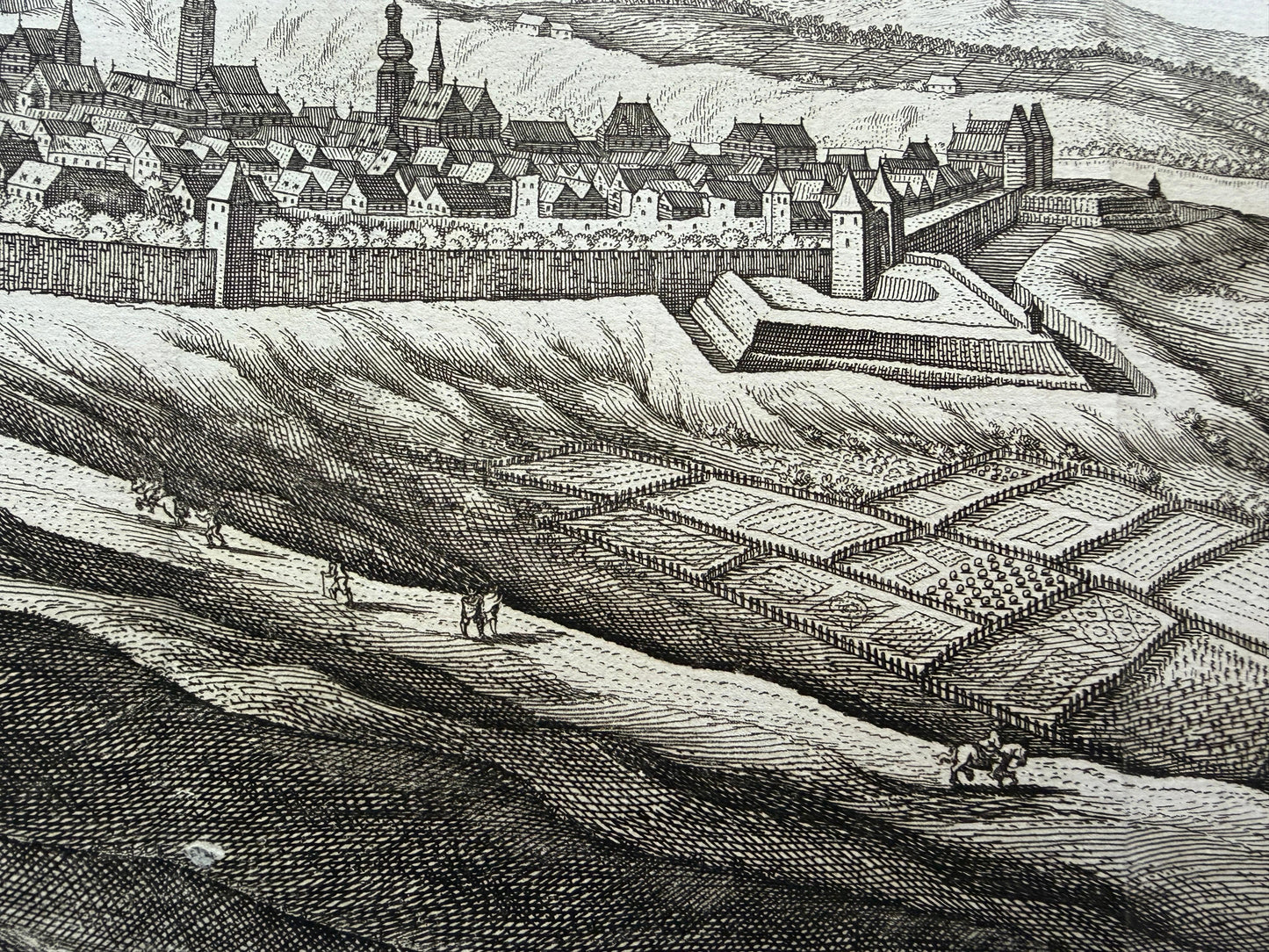
The drawing for the copperplate engraving was created by Karel Škréta (*1610 – †1674), original print circa 1650, 34 x 74 cm, a rich, high-contrast impression on handmade paper with crease marks, printed in an edition of several hundred copies and published in the Frankfurt workshop of Matthäus Merian.
After the defeat of the Estates Uprising in 1620, the Škréta family, as Protestants, left Bohemia and moved to the Netherlands. Karel Škréta himself returned to Prague after studying throughout Europe, converted to Catholicism, and became one of the most significant painters of his time, particularly in the fields of portraiture and religious painting. In addition to his paintings, he also created drawings for prints, including three vedute of Prague; this copperplate engraving is one of them.
The print depicts Prague shortly after the end of the Thirty Years’ War, around 1650. The city’s tranquil atmosphere is emphasized by the foreground scene—a trio of townspeople with a servant taking a stroll in the open countryside outside the city walls in what is now Vinohrady.
The city is depicted as a vast fortified complex with Baroque fortifications, complemented by bastions—forward-deployed artillery positions—that were constructed before the Thirty Years’ War. The panorama encompasses the entire New Town with its dense development and the dominant church towers; on the horizon in the center stands Prague Castle with St. Vitus Cathedral, which at that time had only one tower (the two towers as we know them today were not completed until the early 20th century). On the left side, the Strahov Monastery complex is visible, with vineyards and the Hradčany fortifications on the slopes below it.
At the top of the sheet is a heraldic decoration depicting the coats of arms of Prague’s districts: Prague’s Old Town, Vyšehrad, Lesser Town, Hradčany, and Prague’s New Town.
The veduta combines topographical accuracy with the image’s representational function: Prague is depicted here as a firmly fortified, restored, and stabilized center of the country following a period of wartime upheaval. It represents the most representative and, at the same time, the largest-format graphic depiction of Prague from the mid-17th century, comparable only to the large panorama of Prague—the graphic print/veduta by Václav Hollar.
This print, in various states of preservation, is represented in major domestic and international collections, primarily in the National Gallery in Prague, the National Museum, the Prague City Archives, the Moravian Library, the Albertina in Vienna, the British Museum, the British Library, the Library of Congress in Washington, the Bibliothèque nationale de France in Paris, and others.